From Slap Bracelets to Smart Jewelry: What Our Accessories Can Tell Us
Edited edition: . The original receipt and first-publication dates are unknown.
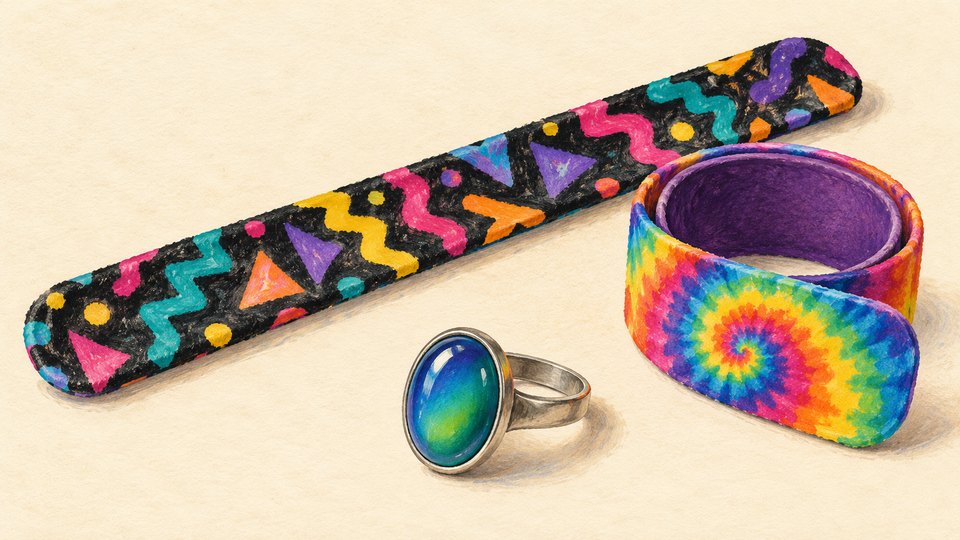
Image description: Illustration of two patterned slap bracelets beside a blue-green mood ring.
A slap bracelet had a simple trick: straighten it, tap it against your wrist, and watch it wrap around. A mood ring offered a more mysterious promise. The changing color was entertaining even when the little chart claimed to know more about your feelings than it could.
Smart jewelry brings a different set of questions. A ring can collect sensor readings and send them to an app, but its shape doesn't tell you what it measures, how the results are calculated, or which features you will pay for.
The accessories we remember
Slap bracelets and mood rings belong to many memories of '90s shops, classrooms, and birthday parties. The memories differ from person to person; these accessories also have histories beyond that decade.
The mood ring's apparent emotional insight needs a correction. The American Chemical Society's explanation describes liquid crystals whose color changes with temperature. A color chart cannot turn that temperature response into a reliable reading of your mood.
An old slap bracelet may need a safety check. A CPSC recall of particular storybook bracelets describes a metal band wearing through its covering. Check an old bracelet's condition and any applicable recall before handing it to a child; this recall doesn't establish that every slap bracelet has the same defect.
Watches made the function visible
A watch can put the time, an alarm, or a stopwatch directly on your wrist. Fitness bands and smartwatches add another layer: sensor readings, software, and information viewed on the device or in a companion app.
Smart jewelry changes the form of that arrangement. A ring or bracelet may fit an outfit differently, while the app does much of the explaining. That can appeal to someone who wants a less visible screen, but it doesn't guarantee less phone use.
What a smart ring actually does
Oura is one example. Its description of how the ring works explains sleep, activity, and readiness information in the Oura App. Read the information for the generation and membership you are considering, rather than assuming every Oura ring or every smart ring has identical features.
The difference between a reading and an interpretation matters. A sensor collects signals; software uses them to produce measures, estimates, or scores. A neatly presented score is still a particular product's interpretation, not a complete account of how you feel.
Oura's notification guidance concerns alerts from the Oura App on your phone. If you want vibration alerts for calls or a message display, check whether the exact device provides them.
The manufacturer also states that Oura Ring is not a medical device. Don't turn a wellness score into a diagnosis or use it alone to change treatment.
Jewelry has taken several forms
Bellabeat's Leaf Urban shows how different smart jewelry can look from a watch. The manufacturer describes a device worn as a bracelet, necklace or clip, without a screen. Its activity and wellness descriptions need the same scrutiny as a watch's claims. A product page mentioning stress does not establish that a device measures your emotions or diagnoses a condition. Check current app support before buying an older design.
Ringly approached jewelry through phone notifications. In a January 2015 company announcement, founder Christina Mercando described the notification ring and its fashion focus. That history needs a date beside it: a January 2018 update said the company had decided not to build or order new products at that time. An old launch announcement cannot tell a buyer whether the app still works today.
Fitbit and Garmin also brought jewelry details into wrist-worn trackers and watches. Fitbit introduced Luxe in April 2021, including a bracelet collaboration with gorjana. Garmin's January 2024 Lily 2 announcement described a patterned lens over a touchscreen. Both are wrist-worn designs with their own interfaces. Check current support and availability before considering an older model.
Style is a useful consideration
A device you dislike wearing may spend more time in its box than on your hand. Consider the shape, finish, fit, and how it feels during the activities you expect to do.
Try the manufacturer's sizing process for the actual model. A smart ring's fit requirements can differ from the jewelry you already wear. Check removal, cleaning, water exposure, charging, and any activity restrictions in the instructions before relying on it for daily use.
Style is personal
A millennial who remembers slap bracelets and a Gen Z buyer trying a first smart ring may want different things from an accessory. Age alone cannot tell us whether either person values a screen, a particular finish or fewer notifications. Choose a design you want to wear and check its functions separately.
Environmental claims need product-level evidence too. If recycled materials or ethical manufacturing affect your choice, look for the manufacturer's specific material and sourcing information. That information should describe the device you are considering.
Questions before buying
- What does the exact model measure, and what does it estimate?
- Where will you see the information: the ring, your phone, or both?
- Which phone and operating system versions are supported?
- Which features require an account, membership, or additional app?
- What happens to your data if you stop paying or stop using the device?
- Can you export or delete your information, and what does the privacy policy say about sharing?
- What are the sizing, return, warranty, and repair terms?
Those details can matter more than the number of features on a product page. Check the total cost over the period you expect to use it, not just the amount paid for the ring.
How much feedback do you want?
Decide which information you will use. If all you want is a record of an activity, a stream of scores and reminders may be unnecessary. Adjust available notification settings to suit your routine.
If monitoring makes you worry more or interferes with sleep, consider stepping back from the dashboard and discussing persistent concerns with a qualified professional. Your response to monitoring is a reason to adjust how you use it.
Authentication and connected homes
Motiv explored a different use for a ring: account security. Its October 2018 announcement introduced two-factor authentication. The announcement also discussed beta features and future passwordless authentication plans. Those plans should not be read as proof that every promised function shipped, or that an old Motiv ring remains supported.
Connected-home controls raise similar questions. Before buying a wearable to work with Alexa, identify the exact device, supported integration and account requirements. A ring that sends readings to a phone does not automatically control a light or unlock a door. Check the current instructions for the whole setup, including what happens when the phone or internet connection is unavailable.
What would make the next accessory useful?
AI software may turn sensor readings into suggestions, but the label alone tells you little about their accuracy. Ask what information the software uses, which decisions it makes and whether you can review or disable its suggestions. Medical claims need evidence about the particular device and intended use.
The idea of augmented-reality or holographic jewelry belongs with speculation until a working product can be assessed. Blade Runner offers a reference for imagining future technology; a fictional scene cannot establish what a wearable can do. The useful buying question is what the device does now.
Solar charging and new materials are other possibilities to assess when a particular product supports them. Check the specifications before expecting either feature in the jewelry you buy.
Sustainability also needs details. Look for repair options, battery replacement, software support and disposal instructions. A smaller device can still become unusable when its battery fails or its app closes. Check those terms before choosing a finish or paying for extra features.